Awajishima Tenobe Somen
| Registration Number | 176 |
|---|---|
| Name of the GI | Awajishima Tenobe Somen、Awaji Somen |
| Class | Processed Foodstuffs |
| Date of Protection | 2026/03/25 |
| Producing Area |
Hyogo Prefecture
Minamiawaji City |
| Applicant - Name and Address | Awaji Tenobe Somen Cooperative Association 1573-3 Fukura Otsu, Minamiawaji City, Hyogo Prefecture |
Characteristics
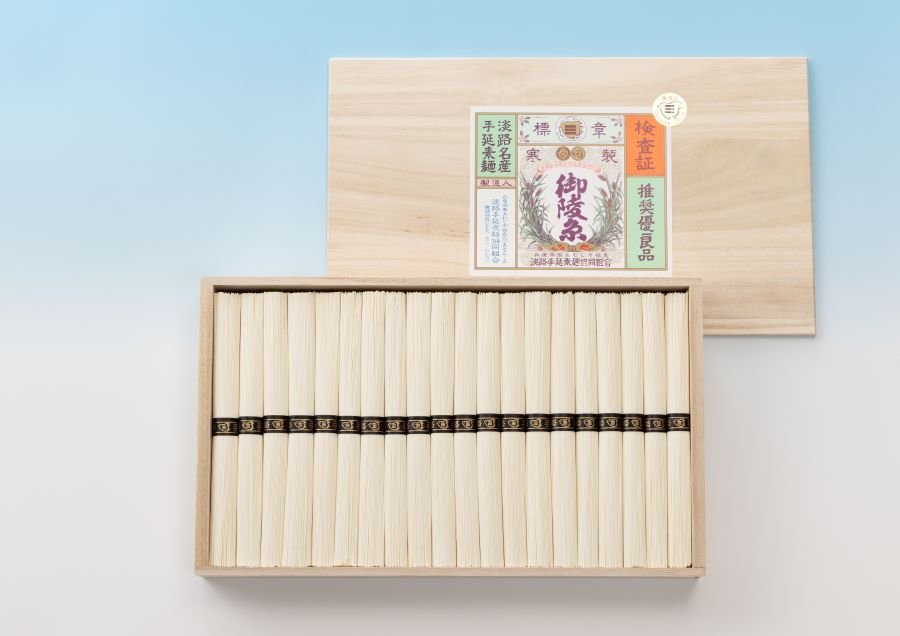
"Awajishima Tenobe Somen" is a type of tenobe (hand-stretched) somen (1) that has been produced in Minamiawaji City since the Tempo era (1830-1843) of the Edo period. It is highly regarded by somen restaurants and long-established ryokan inns for its thinness, smoothness when swallowed, firmness, refined flavor, and rarity due to its traditional production methods. The sight of extremely fine noodles hanging like a curtain from a height of more than 2 m, swaying in the wind as they dry in the sun, is known as the "art of white threads" and is a cherished feature of winter on the island.
Production method
Producers use ingredients that meet the standards established by the Awaji Tenobe Somen Cooperative Association (hereinafter referred to as the "Association"). They also follow the Association's standards for ingredient proportions, including wheat flour, dough resting times, and the height used for kado-boshi, the process of stretching and drying the noodles. Production is limited to October through the following April. Only noodles that meet the shipment standards for appearance, thickness and other characteristics are shipped.
Link with the production area
The origins of "Awajishima Tenobe Somen" are said to date back to the Tempo era when Watari Shichihei, a fisherman of Fukura, learned how to make somen in Miwa, Yamato, on his return journey from a pilgrimage to Ise and brought the techniques back to Awaji Island. The production area is relatively mild even in winter, and the Yuzuruha Mountains (2) shelter it from strong seasonal winds. With little rain or snow and many dry days, the area offers ideal conditions for making high-quality somen. These climatic conditions helped noodle making develop as a winter side business for farmers and fishermen.
Even today, artisans called "itodeshi" continue to preserve traditional hand-stretching techniques without adopting full-scale mechanization. For the main product, superfine somen, the dough is left to rest slowly overnight and stretched between midnight and early morning, when temperatures are low and stable. Distinctive techniques, including adjusting resting times and production steps according to noodle thickness, continue to be passed down.
- Tenobe somen noodles, which are hand-stretched, are made by kneading wheat flour with salt water. Vegetable oil is applied to the dough, which is then stretched into thin strings while being twisted and dried . According to the Food Labeling Standards, those thinner than 1.7 mm along the longer diameter can be labeled as tenobe somen. These delicate, pure white noodles are typically boiled, cooled in cold water, and served with a dipping sauce. Enjoyed as a popular seasonal tradition during the summer in Japan, somen can also be served in winter as a hot soup called "nyumen." Thus, somen is an important part of Japanese food culture.
- The Yuzuruha Mountains extend from east to west across southern Awaji Island and include Mt. Yuzuruha (608m above sea level), the highest peak on the island.




 Japanese
 English