Geographical Indication
What is Geographical Indication?
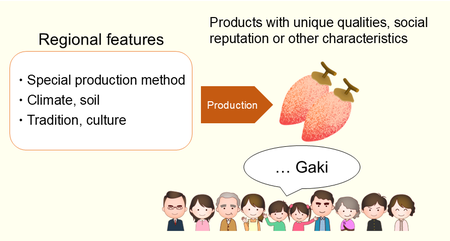
A geographical indication (GI) is the name given to a product that possesses characteristics unique to a particular region.1)
Examples include Ichida Gaki (dried persimmons), Kobe Beef, and Echizen Crab.
GI is different from the "indication of origin", which only shows the region where a product was produced.
As illustrated in the following diagram, a geographical indication refers to the name of a product that has unique qualities or social reputation, and whose characteristics have been developed through special production methods nurtured over many years, and/or climate, soil, traditions, culture in the region.2)
References:
1) The TRIPS Agreement (Annex 1C of the Marrakesh Agreement Establishing the World Trade Organization) defines geographical indications as follows:
"indications which identify a good as originating in the territory of a member, or a region or locality in that territory, where a given quality, reputation or other characteristic of the good is essentially attributable to its geographical origin".
2) The nature and extent of a product's characteristics vary depending on the registered GI products. To view the registeredcharacteristics of each GI product, please refer to the first paragraph of the introductory text on that product's page on this site.
What is the Geographical Indication (GI) Protection System?
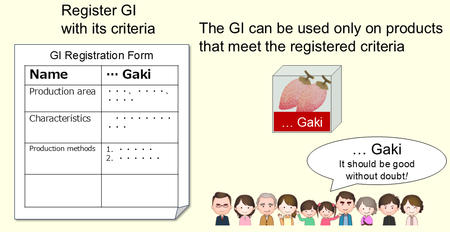
Producers of a product with characteristics unique to their region can transmit the product's value to consumers by using a geographical indication. When consumers see a GI label, they can, for example, expect that "this product should have a delicious aroma because it is cultivated in that region's distinctive climate," or "this product should have a special flavor because it is produced using the area's traditional method".
However, suppose the same name were used for products made in different areas and/or by other methods, or for items that have lost their original qualities. In that case, consumers may be disappointed, and genuine producers in the region could incur significant losses.
To prevent this, the geographical indication (GI) protection system registers and protects GIs together with their criteria, such as the production area, product characteristics, and production methods. Only products that meet the registered criteria are allowed to bear the registered GI label, ensuring that consumers can confidently trust and select products carrying the GI mark.
Geographical Indication (GI) Act in Japan
In Japan, geographical indications (GIs) for agricultural, forestry, and fishery products, as well as food items, are registered under the Act on Protection of the Names of Specific Agricultural, Forestry and Fishery Products and Foodstuffs (commonly known as the Geographical Indication Act), which was established in June 2014 and came into effect in June 2015. Suppose a product that does not meet the registered standards is found to be using a registered GI. In that case, the authorities take administrative action to treat such use as unauthorized and to protect the registered geographical indication from misuse.
Reference: Website of the Ministry of Agriculture, Forestry and Fisheries on "Geographical Indication (GI) protection system in Japan" under "Geographical Indication (GI) protection system"
The GI protection system for alcoholic beverages is administered under a public notice issued by the National Tax Agency under the Liquor Tax Act (National Tax Agency Public Notice No. 19, issued on October 30, 2015).
Reference: National Tax Agency JAPAN/ Geographical Indication (GI)
GI Mark
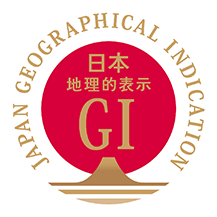
Products registered under Japan's GI system may display the GI Mark alongside their Geographic Indication.
Since November 2022, products made using GI-registered raw materials have also become eligible to display the GI Mark, provided they meet certain prescribed conditions.
The GI Protection System Has Global Reach
The geographical indication (GI) protection system originated in European nations such as France and Italy. In Europe, numerous GIs have been registered and protected for products such as cheese, ham, and wine. Examples include Parmigiano-Reggiano and Champagne.
Today, more than 100 countries have introduced GI protection systems.
Typically, each country operates its own system (in the EU, a single unified framework covers the entire region). However, since many high-quality products are traded internationally, a mechanism for cross-border protection of GIs is necessary.
To achieve this, nations enter into agreements to recognize and protect each other's registered GIs mutually. For example, Japan and the EU have concluded the Japan-European Union Comprehensive Economic Partnership Agreement, which entered into force in February 2019. This agreement includes provisions for the mutual protection of designated GIs.
References:
- List of EU GIs protected in Japan
- "GI View" - the EU's database of protected GI products
(By selecting "Japan" under "Country," you can view the list of Japan's GIs protected within the EU.)


 Japanese
 English